


Discount

Gyokuro Tonbo - Organic Japanese Green Tea
Available, delivery time: 1-3 working days (in Germany)
(€900.00
*
/ 1 kg)
€36.00
*
€45.00
(20% saved)

Gyokuro Tsuru - Organic Japanese Green Tea
Available, delivery time: 1-3 working days (in Germany)
(€1,425.00
*
/ 1 kg)
€57.00
*
Skip product gallery

Goes well with:

Kyusu-teapot, round, black, 180 ml
This round kyusu with a fine ceramic strainer is handcrafted by the Jinsui manufacture in Tokoname.
Japanese kyusu side handle teapots are ideal for brewing green tea.The tea leaves can unfold freely in the pot and are retained by an integrated strainer in front of the spout during infusion.
Dimensions
The filling quantity of the pot should be chosen in such a way that the tea can be completely distributed over the waiting cup(s) and no water remains in the pot.The leaves remain in the pot and are then simply brewed again briefly with water for further infusions.
Practical filling quantity: 180ml Maximum filling quantity: 250mlFor 1-2 persons .Variations
Please note that the shape, color and size of the tea ceramics may vary slightly, especially for pieces like this handmade!
Cleaning
For cleaning in everyday use, simply tap out the tea set and rinse well with clear water even through the strainer. If after prolonged use, the strainer has slowly clogged, you will find instructions here for the care and cleaning of your teapot - for unadulterated tea enjoyment: Cleaning Instructions for Teapots
Product number:
41111.1
Available, delivery time: 1-3 working days (in Germany)
€63.00
*
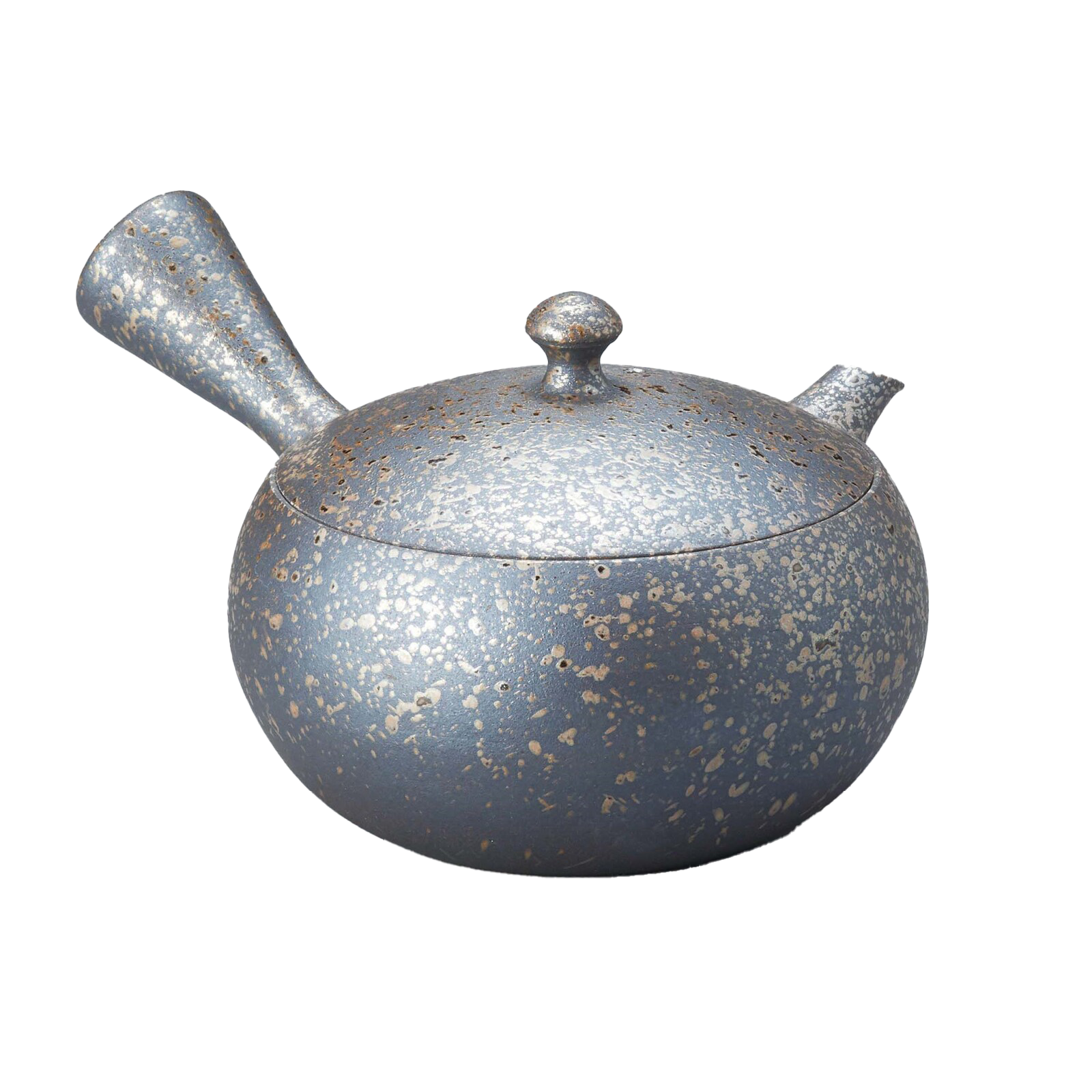
Kyusu-teapot with golden speckles
The elegantly crafted anthracite coloured pot with golden speckles was handmade by Tokuta Fujita in Tokoname, a town famous for its potteryJapanese Kyusu side handle teapots are ideal for brewing green tea.The tea leaves are free to unfold in the pot and are retained by an integrated strainer in front of the spout during infusion.
The filling quantity of the pot should be chosen in such a way that the tea can be completely distributed over the waiting cup(s) and no water remains in the pot.The leaves remain in the pot and are then simply brewed again briefly with water for further infusions.
Capacity: 160mlFor 1-2 persons
The filling quantities are measured to the rim in each case - the actual amount in daily use is somewhat smaller.
Deviations
Please note that shape, color and size of the tea ceramics may vary slightly!This is especially true for teapots, which are all at least partially handmade.
Cleaning
For cleaning in everyday use, simply tap out the tea set and rinse well with clear water, even through the strainer. If, after prolonged use, the strainer has slowly become clogged, you will find instructions here for the care and cleaning of your teapot - for unadulterated tea enjoyment: Cleaning instructions for teapots
Product number:
41104.1

Shiboridashi-Kännchen, rot mit dunklen Spritzern
Shiboridashi-Kännchen werden hauptsächlich für die Zubereitung von Gyokuro Tee verwendet, aber auch andere (nicht zu feinblättrige) Tees können mit diesen Kännchen aufgegossen werden Statt einem klassischen Sieb wird das befüllte Kännchen mit dem Deckel verschlossen und der Tee über Rillen in der Tülle ausgeschenkt, während der Deckel die Blätter zurück hält.Das flache Kännchen aus rotem Ton wird von dem Künstler Hakusan in Handarbeit gefertigt und mit dunkelroten Akzenten verziert. Shiboridashi-Kännchen haben kein Sieb im eigentlichen Sinne sondern einen Ausguss mit Kerben im Ton, durch die der Tee abgegossen wird, während die Teeblätter mit dem Deckel zurückgehalten werden.Diese Kännchen eignen sich vor allem für weniger stark gedämpfte Tees mit größeren Blättern wie zum Beispiel Gyokuro.Die Füllmenge des Kännchens sollte so gewählt werden, dass der Tee komplett auf die bereitstehende(n) Tasse(n) verteilt werden kann und kein Wasser im Kännchen verbleibt. Die Blätter bleiben im Kännchen und werden dann einfach für weitere Aufgüsse erneut kurz mit Wasser überbrüht.MaßeFüllmenge 100mlFür 1-2 Personen.AbweichungenBitte beachten Sie, dass Form, Farbe und Größe der Teekeramik leicht variieren können!Insbesondere gilt dies für Kännchen wie dieses, die in Handarbeit erstellt werden.Reinigung Die Reinigung ist bei einem Shiboridashi-Kännchen denkbar einfach: den Teesatz ausklopfen und mit klarem Wasser ausspülen.
Product number:
41101.1
Available, delivery time: 1-3 working days (in Germany)
€143.00
*

Teacup, white with blue vines, 60 ml, set of 5
Set of 5 small, white porcelain tea bowls with blue rank decoration for particularly fine teas or tastings.
Especially the high quality teas are often drunk from small pots and bowls in Japan - also because these are more productive and instead of one infusion with a large quantity, many infusions are made with smaller portion sizes.
Variations
Please note that the shape, color and size of the tea ceramics may vary slightly!
Product number:
44000.1
Available, delivery time: 1-3 working days (in Germany)
€45.00
*

Teacup, white with pine needle, 90 ml, set of 5
Small, white porcelain tea bowls in a set of 5. Well suited for fine teas, which are prepared in small portions (and usually relatively strong), as well as for tastings. The cups are decorated with a traditional symbolic pine needle decor.
Filling quantity 90 ml each.
Please note that the shape, color and size of the tea ceramics may vary slightly!
Product number:
44003.1
Available, delivery time: 1-3 working days (in Germany)
€75.00
*